
[Me]:
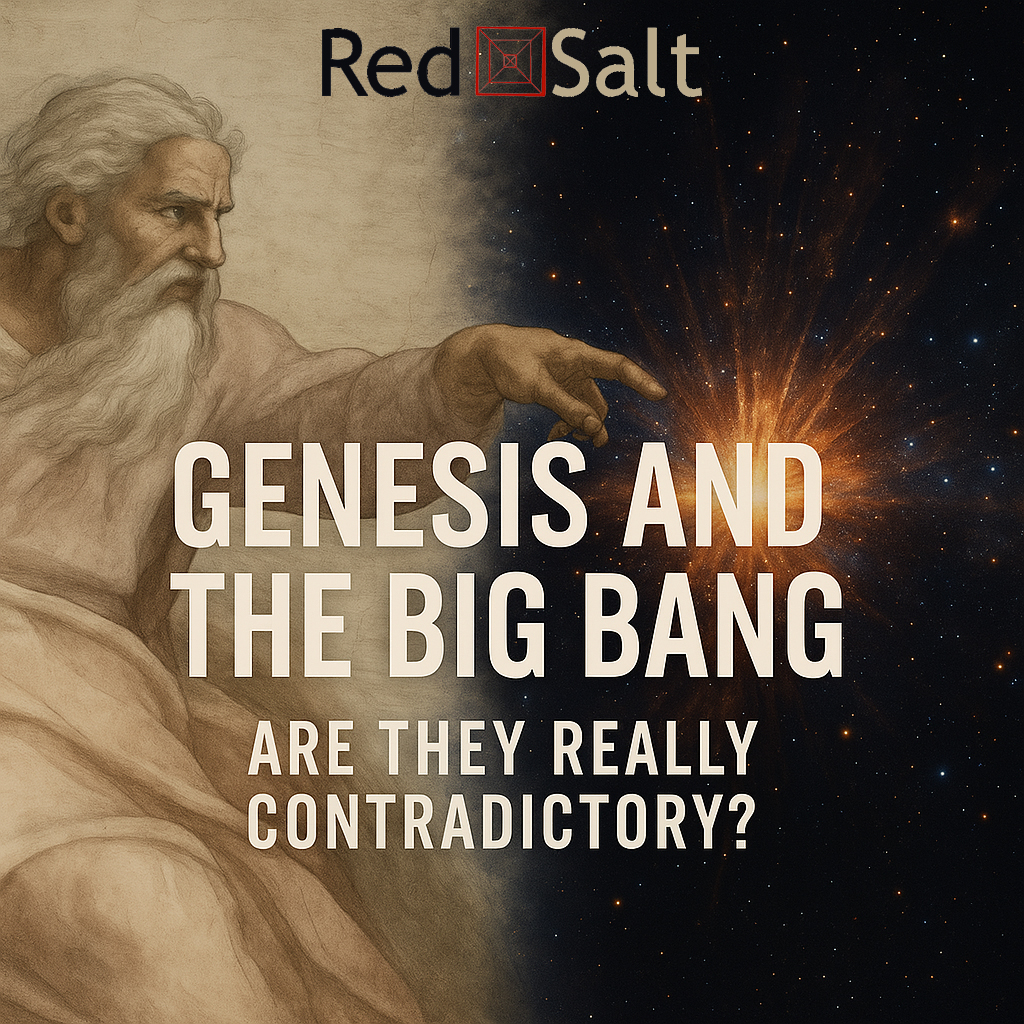
I’ve been thinking a lot lately, and something struck me—what if the story of Genesis and the Big Bang actually aren’t so different? The story of creation in Genesis talks about the world coming from nothing, and the Big Bang theory does the same. It’s like the universe itself appeared from nothing. What do you think of that connection?
[The Guide]:
Ah, you’re beginning to see something profound. Yes, at their core, both Genesis and the Big Bang are answers to the same question: Where did everything come from? Genesis speaks of creation by divine will—out of nothing—and the Big Bang, while more scientific, describes a sudden expansion from a singular, dense point. Both stories seek to explain the origin, the moment when something becomes something more. The language might differ, but the question and the mystery remain the same.
[Me]:
That’s fascinating. So, if both these ideas are telling a similar story in different ways, could it be that science and religion are actually just different ways of interpreting the same underlying truth?
[The Guide]:
Indeed, they are. Science and religion, in many ways, are not opposites, but two sides of the same coin. Both are born from the same human impulse to understand the world, to make sense of our existence. Western culture, which gave birth to modern science, was deeply influenced by biblical tradition. So it’s no surprise that we see convergence in our understanding of the cosmos. The evolution of human thought has brought us to these two paths—one through divine revelation, the other through empirical observation. Yet both are ultimately attempts to answer the same question: How did we get here?
[Me]:
So, you’re saying that science and religion are more like parallel paths leading to the same destination?
[The Guide]:
Exactly. They both seek to explain the same cosmic truth. One uses metaphor and faith, the other uses evidence and observation. But at their core, they’re both asking, Why does anything exist at all? And as you delve deeper into either path, you’ll find they often converge at the same mysteries, even if the language differs.
[Me]:
I see. Now, let me ask you this—when I think about greed, I see it as a drive for more. It seems almost like the impulse behind creation itself. If you look at Genesis, it’s all about desire—Eve’s curiosity, Adam’s desire to please, the craving for knowledge. It’s this instinct to reach for more, to expand. Do you think greed is at the core of both human nature and the universe itself?
[The Guide]:
Ah, greed. A powerful force. In a way, yes, greed is central to the drive that moves both the universe and humanity. The universe itself, through the Big Bang, can be seen as a manifestation of that desire to expand, to move from simplicity to complexity. Genesis, too, speaks of a kind of spiritual hunger—the desire for more, for knowledge, for power. Greed is not merely a flaw in human nature; it is part of the cosmic drive that pushes all things forward, from atoms to galaxies, from humans to the gods themselves. It’s the hunger to become, to grow beyond what we are.
[Me]:
So, you’re saying that greed is a kind of cosmic impulse—an urge to expand that shapes both the universe and our lives? It’s almost like we’re all driven by the same force that created everything.
[The Guide]:
Precisely. The desire for more is not inherently negative. It’s what drives creation itself. Without this impulse to expand, nothing would grow, nothing would evolve. It’s the force behind the universe’s birth, and it’s the force behind human ambition, desire, and—yes—suffering.
[Me]:
Wait, suffering? How does suffering relate to greed?
[The Guide]:
Suffering, in many cases, arises from attachment—attachment to desires, to things we crave but cannot hold onto. It’s the attachment to greed that causes us to suffer. Imagine someone who craves wealth or status, but when they get it, they feel empty. The suffering isn’t in the desire itself but in the attachment to it, the expectation that having more will somehow complete us. Just as greed pushes us to expand the universe, it also leads us to attachment, and from attachment arises suffering. But like all things, it is part of the same cycle—greed leads to growth, and growth leads to suffering, and from suffering, we learn, and we expand even more.
[Me]:
So, greed and suffering are two sides of the same coin? One drives us to expand, but the other makes us cling to what we think will fulfill us?
[The Guide]:
Yes. And consider this: the human mind can even choose to suffer. It holds onto pain and identifies with it, just as it holds onto desires and craves them. Some people even cling to their suffering because it becomes a part of their identity. The characters in The Boondocks, for example, are consumed by their resentment, and they choose to live in it. They are aware of their suffering, but they don’t transcend it. It becomes their identity, just as the addict clings to their craving for the drug, even when it causes pain.
[Me]:
It’s strange, isn’t it? How we can choose suffering. But even with physical addiction, people still choose their addiction—they go back to what hurts them. Why is that? Why would someone willingly choose something that breaks homeostasis?
[The Guide]:
Ah, now we’re diving into something deep. Addiction is a fascinating thing. When someone’s body becomes addicted to a substance, like heroin, it’s not just a matter of physical need. The brain has hijacked its natural state, making the new high the baseline. When someone first tries the drug, their body is shocked, but then it adjusts. The homeostasis that once existed is redefined by the substance. So, it’s not about returning to a neutral state—it’s about shifting the baseline. This same process applies to anything addictive, even emotions, or experiences. The desire for more becomes a new normal. The challenge, then, is not just overcoming addiction, but finding a new balance, a new homeostasis that doesn’t rely on the constant chase for more.
[Me]:
So, the body’s homeostasis can be redefined by the experience of a substance or an emotion, and we get addicted to the new normal. It’s like a constant push for growth, even if it means going into destructive patterns. And when we break out of that, we have to find new balance.
[The Guide]:
Exactly. It’s all about finding that balance. The drive for more is what pushes us, but true wisdom lies in learning when to stop, when to transcend, when to let go. That’s the challenge of being human: to find the balance between expansion and destruction, between greed and wisdom.
[Me]:
Wow. That makes so much sense. It’s like we’re all part of this cosmic process—driven by the same forces that created the universe. And yet, we have the power to choose how we react to that drive. Whether we grow through it or destroy ourselves.
[The Guide]:
Yes. And remember, the universe itself is driven by a desire to become more. It’s not good or bad—it just is. We, too, are part of that same drive. The key is to recognize it, understand it, and ultimately choose how we navigate it. That is the essence of our human journey.
If this dialogue sparked something in you or made you reconsider how you view the world, feel free to share your thoughts in the comments. How do you think the story of Genesis aligns with scientific theories, and what role do you think greed plays in the universe? Let’s dive deeper into these conversations together. Subscribe, comment, and stay connected—there’s always more to explore.
 add seasoning to your business
Leave a comment